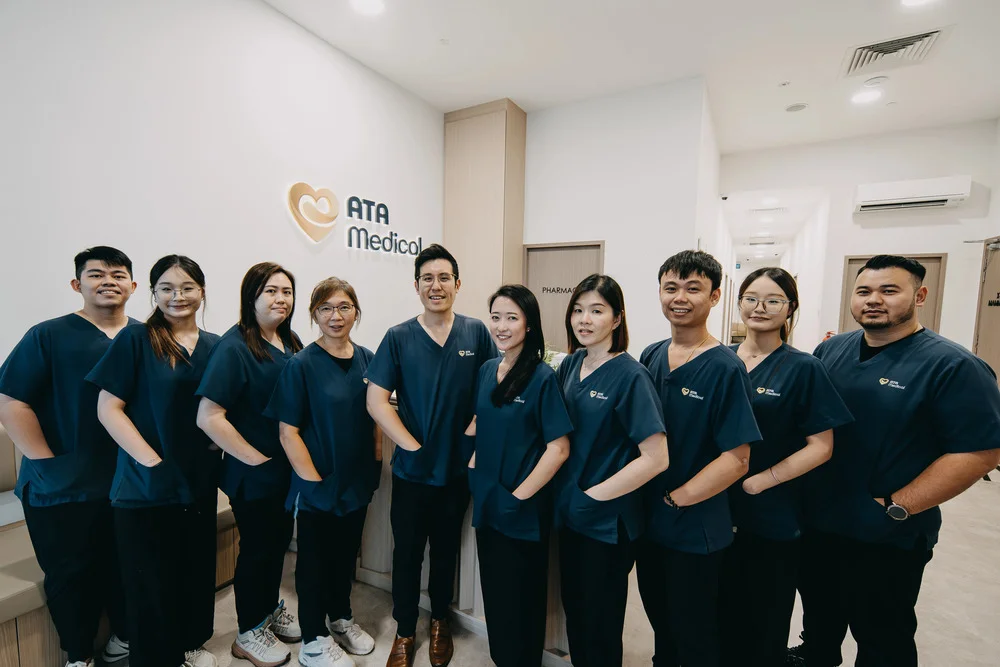
Dr Natalia Sutiman is a medical doctor whose approach to care is shaped by her background in both pharmacy and clinical research. She earned her Doctor of Medicine from Duke-NUS Medical School. Prior to that, she worked as a pharmacist at Tan Tock Seng Hospital and in Clinical Pharmacology research with SingHealth, where she contributed to clinical trials, therapeutic drug monitoring and genomics studies.
Her medical training spans rotations across multiple disciplines at Singapore's major hospitals, including Internal Medicine and Emergency Medicine at Singapore General Hospital, Paediatric Medicine at KK Women's and Children's Hospital, and primary care at SingHealth Polyclinics. This breadth of training equips her to care for patients across all ages and a wide range of conditions.
While her experience spans clinical medicine, pharmacy and research, Dr Natalia has always been drawn to the human aspects of patient care. She places great importance on listening with intention, communicating medical decisions with clarity, and working closely with her patients to support their long-term health.
Clinical Focus
Preventive Medicine
Proactive health strategies and screening to identify and address health risks early.
Acute & Chronic Care
Management of both immediate medical concerns and long-term health conditions.
Diagnostic Assessment
Careful evaluation of complex or evolving symptoms to guide a clearer diagnosis.
Women's Health
Comprehensive healthcare addressing the unique needs of women at every stage of life.
Research-Informed Care
A science-based approach shaped by published medical research and clinical experience.
Approach to Patient Care
“
"I believe that good care starts with genuinely understanding each patient's concerns and circumstances. Having trained in both research and clinical medicine, I try to ensure that every treatment plan is grounded in evidence and suited to the individual."
Dr Natalia Sutiman
"I believe that good care starts with genuinely understanding each patient's concerns and circumstances. Having trained in both research and clinical medicine, I try to ensure that every treatment plan is grounded in evidence and suited to the individual."
Dr Natalia Sutiman
Research & Publications
Before entering clinical practice, Dr Natalia built a research career spanning more than 400 citations in peer-reviewed journals. Her work in pharmacogenomics explored how genetic differences in Asian populations influence medication response, particularly across cancer and inflammatory disease treatments.
Published Works
Identifying the thresholds of C-reactive protein, procalcitonin, and interleukin-6 among children ≤ 36 months' old with fever without source at risk of serious bacterial infections: A systematic review and meta-analysis
2026 |Frontiers in Pediatrics, Vol. 14, 1697210 | Sutiman, N., Lin, J., Sultana, R., Yao, S. H. W., Goh, S. S. M., Rocknathan, S.-K., Ganapathy, S., & Chong, S.-L. | doi.org/10.3389/fped.2026.1697210
Asthma exacerbation in children — Is there pneumonia?
Protocol for the diagnostic performance of C reactive protein, procalcitonin and interleukin-6 for serious bacterial infections among children ≤ 36 months old presenting with fever without source: A systematic review and meta-analysis
2024 |BMJ Paediatrics Open, 8(1), e002237 | Sutiman, N., Yao, S. H. W., Goh, S. S. M., Sultana, R., & Chong, S.-L. | doi.org/10.1136/bmjpo-2023-002237
Delayed presentation is associated with serious bacterial infections among febrile infants: A prospective cohort study
2024 |Annals of the Academy of Medicine, Singapore, 53(5), 286–292 | Rajoo, K. P., Sutiman, N., Shih, S., Khoo, Z. X., Ong, G. Y.-K., Wong, L., Piragasam, R., Ganapathy, S., & Chong, S.-L. | doi.org/10.47102/annals-acadmedsg.2023350
Cross-ancestry genome-wide association study defines the extended CYP2D6 locus as the principal genetic determinant of endoxifen plasma concentrations
2023 |Clinical Pharmacology & Therapeutics, 113(3), 712–723 | Khor, C. C., Winter, S., Sutiman, N., Mürdter, T. E., Chen, S., Lim, J. S. L., et al. | doi.org/10.1002/cpt.2846
Cooperative regulation of coupled oncoprotein synthesis and stability in triple-negative breast cancer by EGFR and CDK12/13
2023 |Proceedings of the National Academy of Sciences, 120(38), e2221448120 | Ang, H. X., Sutiman, N., Deng, X. L., Liu, A., Cerda-Smith, C. G., et al. | doi.org/10.1073/pnas.2221448120
Validation and comparison of the PECARN rule, Step-by-Step approach and Lab-score for predicting serious and invasive bacterial infections in young febrile infants
2022 |Annals of the Academy of Medicine, Singapore, 51(10), 595–604 | Sutiman, N., Khoo, Z. X., Ong, G. Y.-K., Piragasam, R., & Chong, S.-L. | doi.org/10.47102/annals-acadmedsg.2022193
A phase 1b study of OXIRI in pancreatic adenocarcinoma patients and its immunomodulatory effects
2022 |International Journal of Cancer, 151(3), 435–449 | Ng, M., Chen, S., Ong, W. S., Balachander, A., Seet, A., Yeong, J., Sutiman, N., et al. | doi.org/10.1002/ijc.34021
Survival outcomes of paediatric patients with acute myeloid leukaemia treated with the MASPORE 2006 protocol
2021 |Clinical Lymphoma Myeloma and Leukemia, 21(3), e290–e300 | Sutiman, N., Nwe, M. S., Lai, E. E. N., Lee, D. K., Chan, M. Y., Yeoh, A. E.-J., Soh, S. Y., Leung, W., & Tan, A. M. | doi.org/10.1016/j.clml.2020.11.016
Cooperative regulation of coupled oncoprotein translation and stability in triple-negative breast cancer by EGFR and CDK12
2021 |BioRxiv, 2021.03.03.433762 | Ang, H. X., Sutiman, N., Deng, X. L., Bartelt, L. C., Chen, Q., et al. | doi.org/10.1101/2021.03.03.433762
Protocol for the diagnostic performance of C-reactive protein, procalcitonin and interleukin-6 for serious bacterial infections among children ≤ 36 months old presenting with fever without source
2021 |Health, 8 | Sutiman, N., Yao, S. H. W., Goh, S. S. M., Sultana, R., & Chong, S. L.
Alterations in drug pharmacokinetics in critically ill children supported on extracorporeal membrane oxygenation: A systematic review
2020 |Australian Critical Care, 33, S2–S3 | Sutiman, N., Watt, K., Hornik, C., Koh, J. C., Murphy, B., Chan, Y. H., & Lee, J. H. | doi.org/10.1016/j.aucc.2020.04.006
An intronic FTO variant rs16952570 confers protection against thiopurine-induced myelotoxicities in multiethnic Asian IBD patients
2020 |The Pharmacogenomics Journal, 20(3), 505–515 | Chen, S., Tan, W. Z., Sutiman, N., Lim, C., Lee, S. S., Leong, W. F., et al. | doi.org/10.1038/s41397-019-0126-9
Pharmacokinetics alterations in critically ill paediatric patients on extracorporeal membrane oxygenation: A systematic review
2020 |Frontiers in Pediatrics, 8, 260 | Sutiman, N., Koh, J. C., Watt, K., Hornik, C., Murphy, B., Chan, Y. H., & Lee, J. H. | doi.org/10.3389/fped.2020.00260
Predictive role of NUDT15 variants on thiopurine-induced myelotoxicity in Asian inflammatory bowel disease patients
2018 |Pharmacogenomics, 19(1), 31–43 | Sutiman, N., Chen, S., Ling, K. L., Chuah, S. W., Leong, W. F., et al. | doi.org/10.2217/pgs-2017-0147
EGFR mutation subtypes influence survival outcomes following first-line gefitinib therapy in advanced Asian NSCLC patients
2017 |Journal of Thoracic Oncology, 12(3), 529–538 | Sutiman, N., Tan, S. W., Tan, E. H., Lim, W. T., Kanesvaran, R., et al. | doi.org/10.1016/j.jtho.2016.11.2225
Influence of the KDM4A rs586339 polymorphism on overall survival in Asian non-small-cell lung cancer patients
2017 |Pharmacogenetics and Genomics, 27(3), 120–123 | Marvalim, C., Wong, J. X. G., Sutiman, N., Lim, W. T., Kanesvaran, R., et al. | doi.org/10.1097/fpc.0000000000000266
Pharmacogenetics of ABCB5, ABCC5 and RLIP76 and doxorubicin pharmacokinetics in Asian breast cancer patients
2017 |The Pharmacogenomics Journal, 17(4), 337–343 | Lal, S., Sutiman, N., Ooi, L. L., Wong, Z. W., Wong, N. S., Ang, P. C. S., & Chowbay, B. | doi.org/10.1038/tpj.2016.17
A phase I pharmacokinetic study of metronomic vinorelbine and sorafenib using two schedules in Asian NSCLC patients
2017 |Annals of Oncology, 28, x39–x40 | Chen, S., Sutiman, N., Shih, V., Tan, D., Ang, M. K., et al. | doi.org/10.1093/annonc/mdx658.003
Therapeutic drug monitoring of thiopurines in the management of Asian patients with inflammatory bowel disease
2016 |Journal of Crohn's & Colitis, 10, S307–S308 | Chuah, S. N. W., Delord, P., Sutiman, N., Leong, W. F., Kong, S. C., et al. | doi.org/10.1093/ecco-jcc/jjw019.534
Phase I study of oral vinorelbine in combination with erlotinib in advanced non-small cell lung cancer (NSCLC) using two different schedules
Effects of oxaliplatin, capecitabine and irinotecan (OXIRI) on pancreatic ductal adenocarcinoma cell lines carrying different Kras mutational status
2016 |Journal of Clinical Oncology, 34(15_suppl), e15722 | Chowbay, B., Wong, J. X. G., Marvalim, C., Ng, S. L., Sutiman, N., & Leong, W. F. | doi.org/10.1200/jco.2016.34.15_suppl.e15722
Association of CYP2C19*2 and associated haplotypes with lower norendoxifen concentrations in tamoxifen-treated Asian breast cancer patients
2016 |British Journal of Clinical Pharmacology, 81(6), 1142–1152 | Lim, J. S. L., Sutiman, N., Muerdter, T. E., Singh, O., Cheung, Y. B., et al. | doi.org/10.1111/bcp.12886
Pharmacogenetics of drug transporters in modulating imatinib disposition and treatment outcomes in chronic myeloid leukaemia & gastrointestinal stromal tumour patients
Pharmacogenetics of UGT1A4, UGT2B7 and UGT2B15 and their influence on tamoxifen disposition in Asian breast cancer patients
2016 |Clinical Pharmacokinetics, 55(10), 1239–1250 | Sutiman, N., Lim, J. S. L., Muerdter, T. E., Singh, O., Cheung, Y. B., et al. | doi.org/10.1007/s40262-016-0402-7
Pharmacogenetics of irinotecan, doxorubicin and docetaxel transporters in Asian and Caucasian cancer patients: A comparative review
2016 |Drug Metabolism Reviews, 48(4), 502–540 | Chen, S., Sutiman, N., Zhang, C. Z., Yu, Y., Lam, S., Khor, C. C., & Chowbay, B. | doi.org/10.1080/03602532.2016.1226896
Evaluation of severe neutropenia and diarrhoea in Asian cancer patients receiving UGT1A1 genotype-guided irinotecan dosing
2015 |Journal of Clinical Oncology, 33(15_suppl), e13572 | Sutiman, N., Ramasamy, S., Ng, C. H. M., Choo, S. P., Lim, R. W., et al. | doi.org/10.1200/jco.2015.33.15_suppl.e13572
Influence of EGFR exon 19 mutation subtypes on survival outcomes in advanced stage Asian non-small cell lung cancer patients receiving TKI therapy
2014 |European Journal of Cancer, 50, 32 | Chowbay, B., Singh, O., Sutiman, N., Tan, D. S. W., Lim, W. T., & Tan, E. H. | doi.org/10.1016/s0959-8049(14)70212-6
Pharmacogenetics and its relevance to clinical practice